

How GPS Tracking Helps Electrical Contractors Manage Multiple Crews
An electrical contractor running four crews across four job sites is effectively managing four separate operations, each with its own schedule, materials, and potential challenges. As demand for electrical work continues to grow in 2026, keeping every crew productive and every project on track becomes much harder without real-time visibility.
GPS tracking gives contractors a live view of every crew, van, and trailer, replacing constant check-in calls with accurate, real-time information. With better visibility into vehicle locations, crew movements, and equipment, contractors can improve scheduling, respond to issues faster, reduce downtime, and keep projects running more efficiently. It also complements job costing and crew management software by providing the real-world operational data needed to make better day-to-day decisions.
Key Highlights
- GPS tracking and full crew management software solve different, complementary problems, not the same one.
- The 2026 electrician labor shortage and data center construction boom raise the cost of poor crew coordination.
- GPS and asset tracking give contractors a direct, practical response to the current copper and tool theft crisis.
Why Multi-Crew Coordination Has Gotten Harder in 2026
The U.S. electrical contracting industry is on pace for close to $347.5 billion in revenue in 2026, growing at nearly a 4.8 percent compound annual rate over the past five years. A significant share of that growth traces back to data centers. Construction spending in that category reached a seasonally adjusted annual rate of $50.7 billion in April 2026, up 28.1 percent year over year, and data center construction has now overtaken office and public transportation infrastructure spending for the first time.
More demand would be a simple win if the labor supply were keeping pace, but it is not. The U.S. Bureau of Labor Statistics projects roughly 81,000 electrician job openings per year through 2034, with employment growing about 9 percent, faster than the average occupation, while a large share of the current workforce approaches retirement. The practical result for a contractor is that every crew matters more than it used to. There is no easy option to hire your way out of a coordination problem when the market for licensed electricians is this tight.
Apprenticeship enrollment is responding, and training programs across the country report real growth, but new apprentices need years to become productive journeymen. That gap will not close before this year's busy season does, which is exactly why getting more out of the crews already on payroll matters as much as hiring.
What GPS Tracking Shows a Multi-Crew Contractor
For a contractor juggling several active job sites, GPS tracking turns a fleet of vans and trailers into a single, live operational picture.
- Real-time location of every crew vehicle across every active job site, visible on one map
- Which crew has actually wrapped up at one site and is genuinely available for the next assignment, rather than just scheduled to be
- Job site arrival and departure timestamps for each crew, which double as the raw data for accurate labor allocation by site
- Trailer and equipment location, including generators, lifts, and tool trailers that move between sites independently of any single crew
- Geofencing around each active job site, the yard, and material staging areas, with alerts on unexpected entry or exit
Tracker Systems’ GPS Truck Tracking Devices are built for exactly this kind of dispatch visibility, with reporting frequent enough to show which crew is actually closest, not just which one is scheduled closest.
None of this replaces a superintendent's judgment. It replaces the guesswork and phone tag that judgment currently has to work around.
Protecting Materials and Tools, the Copper Theft Problem
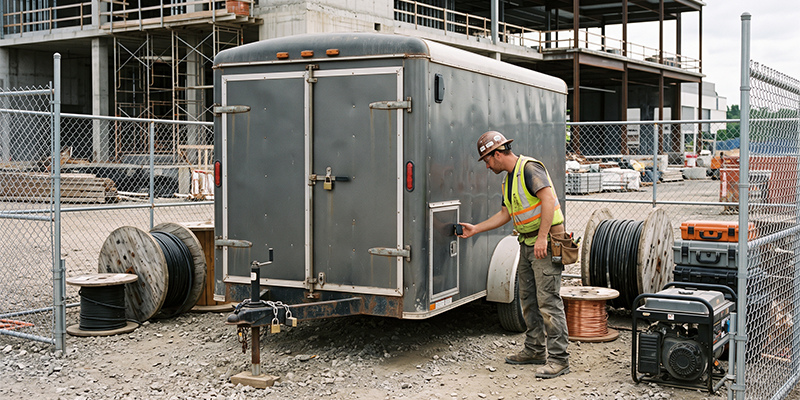
Copper theft is a costly challenge for electrical contractors. Unlike many other trades, electrical crews regularly transport high-value copper wire, making their vehicles, trailers, and job sites attractive targets.
According to the U.S. Department of Energy, metal theft costs U.S. businesses nearly $1 billion every year, with copper accounting for the majority of those losses. The problem continues to grow. In 2025, AT&T reported more than 10,400 copper wire theft incidents, averaging nearly 200 thefts every week. Rising copper prices, fueled by AI data center expansion and grid modernization projects, have made copper even more valuable to thieves.
How GPS Asset Tracking Helps
GPS asset tracking helps contractors respond before a theft turns into a permanent loss.
Key capabilities include:
- Real-time asset tracking: Battery-powered GPS trackers continue reporting the location of trailers, generators, and other equipment, even when they are disconnected from a vehicle.
- Instant geofence alerts: Receive notifications whenever a trailer or asset leaves a job site or storage yard outside of approved hours.
- Improved recovery: Hidden GPS devices, such as covert taillight trackers, continue transmitting location data after a theft, giving law enforcement a much better chance of recovering stolen assets.
Because electrical contractors often manage different types of equipment, many fleets use a combination of battery-powered, solar-powered, and covert GPS trackers to protect trailers and job-site assets. Tracker Systems’ GPS Trailer Tracking page covers battery, solar, and covert options together, since most electrical fleets end up using more than one type across different trailers and job sites.
GPS Tracking vs Full Job Costing and Crew Management Software
GPS tracking and job costing or crew management software serve different but complementary purposes. While their features may overlap, they solve different operational challenges.
A crew management platform combines GPS with tools for scheduling, bidding, invoicing, and job costing. Pricing typically ranges from $6 to $13 per user per month for basic time tracking and GPS features, up to around $299 per month for a full field service management platform.
A GPS-only fleet and asset tracking solution focuses on real-time vehicle and equipment visibility at a predictable per-unit cost. It also integrates with the job costing, ERP, or CRM systems many contractors already use, allowing businesses to add GPS tracking without replacing their existing software.
| Capability | GPS-Only Fleet and Asset Tracking | Full Crew Management Suite |
| Vehicle and trailer location tracking | Yes | Yes, varies by plan |
| Job costing and bidding | No | Yes |
| Crew scheduling and CRM | No | Yes |
| Typical monthly cost | Low, per vehicle or asset | $6 to $13 per user, or up to about $299 per month for full suites |
| Works with your current job costing software | Yes, through integration | Is the job costing software |
For a contractor not ready to migrate to a full crew management platform, or one that already has bidding and invoicing software but lacks real vehicle and trailer visibility, GPS tracking alone delivers most of the coordination and theft protection benefit at a fraction of the cost.
The cost comparison matters in practice, not just on paper. A ten-crew electrical contractor evaluating a full crew management suite at even the lower end of that range is looking at meaningful monthly software cost before adding a single new employee. The same contractor can add GPS and asset tracking across every vehicle and trailer for a fraction of that spend, and decide later, with real usage data in hand, whether a full platform migration is actually worth the larger commitment.
How Real-Time Location Improves Crew Allocation and Job Costing
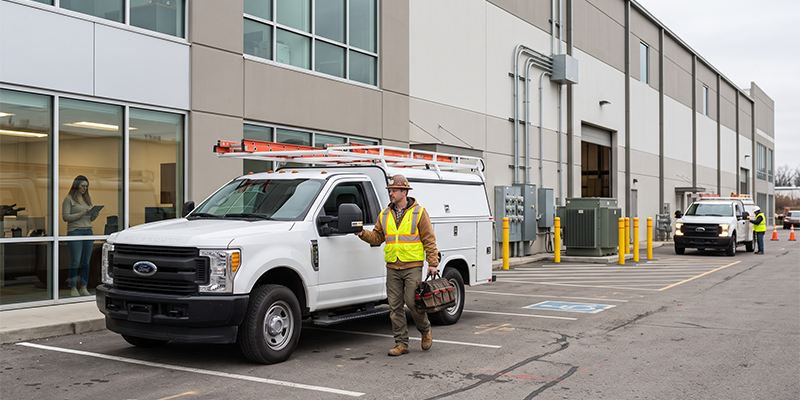
Consider a contractor running six crews across a metro area when a storm knocks out power to a commercial client with a same-day service agreement. Without GPS visibility, the office calls each foreman in sequence to find out who is closest to finishing and who could realistically reach the new site fastest, a process that eats up the exact minutes that matter most in an emergency call. With a live map, the dispatcher identifies the right crew in seconds and reassigns them directly.
The same location data pays off after the emergency ends. Job site arrival and departure timestamps, already being collected for dispatch purposes, provide an accurate, defensible basis for allocating labor hours to the correct job when it is time to run job costing. Instead of reconstructing a crew's day from memory or a paper timesheet, Tracker Systems’ Fleet Tracking Analytics turns the actual routing history into stop reports and runtime reports that show exactly how long each crew spent at each site.
A Quick Implementation Checklist for Multi-Crew Electrical Contractors
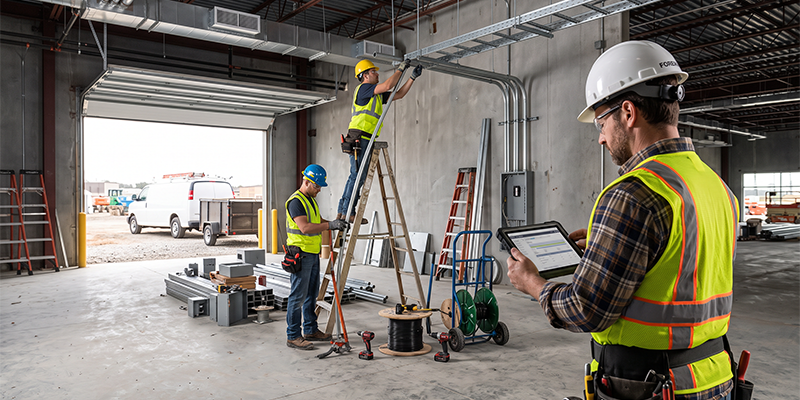
For a contractor rolling this out for the first time, a practical sequence looks like this.
A Practical Rollout Plan
- Start with crew vehicles: They have the highest daily operating costs and provide the greatest value for dispatch and scheduling.
- Track high-value assets: Add battery-powered GPS trackers to tool trailers, generators, and material staging trailers, as these assets often move independently of company vehicles.
- Set up geofences: Create geofences around active job sites, your yard, and material storage areas to receive automatic alerts if assets move outside approved hours.
- Integrate GPS data into job costing: Use automatic arrival and departure timestamps to simplify labor tracking and improve job costing accuracy.
- Protect theft-prone assets: Install covert or battery-powered GPS trackers on equipment and trailers at the highest risk of theft, as visible trackers can be removed.
- Monitor equipment runtime: Enable PTO and auxiliary input monitoring for generators and other powered equipment to support preventive maintenance and improve equipment billing accuracy.
Tracker Systems’ PTO and Auxiliary Input Monitoring covers step six above, and the broader Equipment Tracking Solutions page is a good next stop for contractors weighing how generators, compressors, and job boxes fit into the same tracking plan as vehicles and trailers.
Consider the alternative cost of not having this visibility. A trailer stolen overnight from an unsecured lot, discovered missing only when a crew arrives the next morning, routinely costs a contractor more than the tracker that would have flagged it leaving the yard hours earlier. The math favors visibility every time an incident actually happens, even if most nights nothing happens at all.
If you want to see how this plays out on an active job site, Tracker Systems has also written about how GPS tracking improves safety on construction sites, and contractors who run heavier machinery alongside their electrical crews may also find the construction equipment tracking overview and the best GPS tracker for equipment guide useful next reads.
FAQs
1. How does GPS tracking help electrical contractors manage multiple crews?
GPS tracking shows the real-time location of crews, vehicles, and trailers, helping dispatchers assign the nearest available team and verify arrival and departure times.
2. Is GPS tracking the same as job costing software?
No. GPS tracking provides real-time location data, while job costing software manages scheduling, labor, invoicing, and project costs. Many contractors integrate the two.
3. Why is copper theft a growing concern?
High copper prices have made electrical materials a common target. Copper theft costs U.S. businesses millions each year and continues to increase.
4. Can GPS tracking help recover stolen tools or trailers?
Yes. Battery-powered and covert GPS trackers continue reporting an asset's location after a theft, while geofence alerts notify you of unauthorized movement.
5. Why is GPS tracking especially valuable in 2026?
Growing demand for electrical work and ongoing labor shortages make it more important than ever to improve crew productivity and dispatch efficiency.
6. How many electrician jobs are projected in the coming years?
The U.S. Bureau of Labor Statistics projects about 81,000 electrician job openings annually through 2034, reflecting strong industry demand.
7. What's the difference between GPS tracking and a crew management platform?
GPS tracking focuses on vehicle and asset visibility. Crew management platforms add scheduling, invoicing, job costing, and other field service tools.
8. Do I need a full field service platform?
No. GPS tracking works as a standalone solution and can integrate with your existing job costing or CRM software.
9. How does GPS tracking improve job costing?
Automatic arrival, departure, and travel records provide accurate labor data, reducing reliance on manual timesheets.
10. What should I track first?
Start with crew vehicles, then expand to trailers, generators, and high-value equipment.
11. Can GPS tracking improve emergency response?
Yes. Dispatchers can quickly locate and assign the closest available crew, reducing response times during urgent service calls.
12. Are covert GPS trackers better for theft prevention?
For high-risk assets, yes. Hidden trackers are less likely to be found or removed and continue transmitting location data after a theft.
13. How large is the U.S. electrical contracting industry?
The industry is expected to generate nearly $347.5 billion in revenue in 2026, reflecting continued growth and demand.
14. What is PTO monitoring used for?
PTO and auxiliary input monitoring tracks equipment runtime, helping contractors schedule maintenance and bill accurately for equipment usage.
Coordinating Crews Without the Guesswork
GPS tracking will not replace a good superintendent's judgment, and it is not a substitute for a full crew management platform if your business is ready for one. What it removes is the guesswork underneath every coordination decision, which crew is actually closest, how long a job has really taken, and whether a trailer full of copper and tools is still where it should be.
For electrical contractors who want that visibility without a long-term software migration, or who want it feeding directly into the job costing tools they already use, Tracker Systems has built its fleet and trailer tracking solutions around exactly that kind of flexibility, month-to-month plans with no long-term contracts, and a U.S.-based team that can help match the right device to each part of your operation. Talk to a specialist to find the right setup for your crews.
Recent Posts
-

How GPS Tracking Helps Businesses Meet Fleet Compliance and Regulatory Requirements
One missed 30-minute break. One unlogged mile. That is sometimes all it takes to trigger a roadside …Oct 12th 2026 -

Calculating the ROI of GPS Fleet Tracking for Your Business
Every GPS tracking vendor will tell you that their product pays for itself. Search around, and you w …Oct 5th 2026 -

How GPS Tracking Helps Electrical Contractors Manage Multiple Crews
An electrical contractor running four crews across four job sites is effectively managing four separ …Sep 28th 2026