
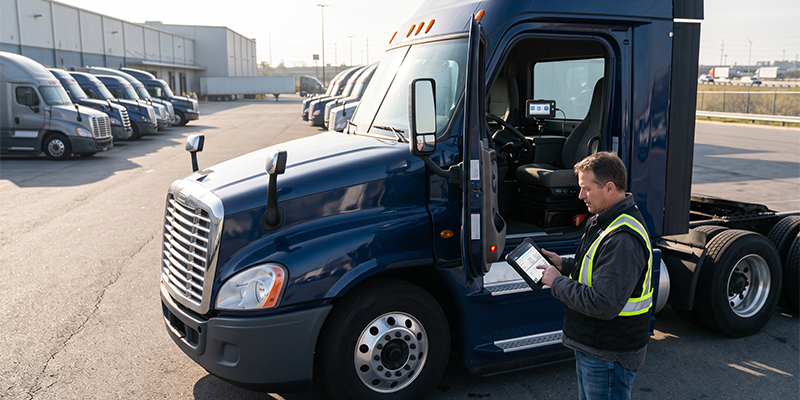
How GPS Tracking Helps Businesses Meet Fleet Compliance and Regulatory Requirements
One missed 30-minute break. One unlogged mile. That is sometimes all it takes to trigger a roadside citation, an out of service order, and lasting damage to a carrier's CSA score. For fleet managers, safety directors, and owner-operators, compliance is not a once a year paperwork task. It is a daily operational discipline, and in 2026 it runs almost entirely on data.
GPS tracking is the foundation of that data. Paired with an FMCSA-registered electronic logging device, a GPS-connected fleet platform gives you the real-time visibility and automated recordkeeping you need to meet Hours of Service, Driver Vehicle Inspection Report, International Fuel Tax Agreement, and Compliance, Safety, Accountability requirements. No paper logs. No frantic phone calls at the end of a shift. No relying on a driver's memory to reconstruct a day.
Below, we break down what fleet compliance includes, where GPS tracking fits in, and where it doesn't and the FMCSA rule changes through mid 2026.
What Fleet Compliance Actually Covers
For most commercial fleets operating under FMCSA authority, compliance is not a single requirement. It is a set of overlapping obligations.
- Hours of Service (HOS). Limits on driving and on-duty time designed to prevent driver fatigue.
- The ELD mandate. The requirement to record HOS electronically through an FMCSA-registered device rather than paper logs.
- Driver Vehicle Inspection Reports (DVIR). Documented pre-trip and post-trip vehicle inspections.
- IFTA reporting. Quarterly fuel tax filings based on mileage driven in each state.
- CSA and the Safety Measurement System (SMS). The scoring system FMCSA uses to rank carrier safety performance across seven categories, called BASICs, including Hours of Service Compliance.
- The Drug and Alcohol Clearinghouse. A federal database of driver drug and alcohol violations that employers must query before every new hire.
Each of these has its own recordkeeping requirements, and manual, paper-based processes create the greatest risk for your fleet.
GPS Tracking vs ELD Compliance, They Are Not the Same Thing
This is where many fleets get compliance wrong. A GPS tracker that reports vehicle location is not automatically an FMCSA-compliant ELD. To satisfy the ELD mandate under 49 CFR Part 395, a device must be certified, listed on FMCSA's registered devices list, and capable of automatically recording engine hours, vehicle motion, and driver duty status through a direct engine connection, not just GPS position.
| Capability | GPS only tracking | FMCSA registered ELD |
| Reports vehicle location | Yes | Yes |
| Tracks speed, idle time, routes | Yes | Yes |
| Produces legally valid HOS logs | No | Yes |
| Satisfies a roadside HOS inspection | No | Yes |
| Requires an engine or ECM connection | No | Yes |
The practical takeaway is simple. A fleet running GPS-only tracking without a registered ELD is not meeting the ELD mandate, no matter how sophisticated that GPS platform looks on a map. What most businesses actually need is a single platform that does both jobs: FMCSA-certified ELD hardware for legally valid HOS records plus GPS-based visibility for dispatch, safety, and day-to-day operations. That combination, instead of two separate tools you have to reconcile by hand, is how Tracker Systems' ELD and HOS compliance solution is built.
How GPS Connected ELDs Automate Hours of Service Compliance
Once a certified ELD is connected to a GPS-based fleet platform, HOS compliance shifts from a manual, after the fact paperwork check to a real-time operational view.
- Automatic duty status logging tied to engine and motion data, which removes manual entry errors and after the fact log edits.
- Live driver dashboards showing exactly who is approaching the 11-hour driving limit, the 14-hour window, or the 60/70 hour weekly cap, before a violation happens.
- Documented exceptions for adverse driving conditions, short haul operation, and sleeper berth splits, annotated at the time they are used.
- Audit ready data retention, accessible any time a DOT or FMCSA reviewer requests records, through live dashboards and reporting instead of a box at a terminal.
The core HOS numbers have not changed since the 2020 Final Rule. Drivers may drive up to 11 hours within a 14 hour on duty window following 10 consecutive hours off duty, with a mandatory 30-minute break after 8 hours of driving and 60/70 hour weekly limits reset by a 34-hour restart.
What has changed is the enforcement environment around those numbers. FMCSA has been removing ELD models from its registered devices list on a rolling basis since late 2025, with new batches revoked nearly every month through 2026. Each revocation triggers a 60-day grace period, and once that window closes, any carrier still running the revoked device is treated as operating without an ELD and is subject to an out of service order at the next inspection. The lesson for fleet managers is simple. Check your ELD's registration status regularly against FMCSA's current list. Do not assume last year's approval still holds.
One paperwork requirement did get lighter this year. Effective July 22, 2026, FMCSA rescinded the requirement to carry a physical copy of the ELD operator's manual in the cab. Drivers still need to understand how their ELD works and be able to produce HOS records and other required documents at roadside. The manual itself just no longer has to physically ride along.
Consider a regional carrier running a dozen trucks out of a single terminal. Before connecting ELDs to a GPS based platform, the safety manager typically found out about an approaching HOS violation after the fact, from a roadside citation or a driver's own log correction. With live duty status dashboards in place, that same manager now gets an alert when a driver is within an hour of the 14 hour window, in time to adjust the remaining stops before a violation occurs rather than explain one afterward. Tracker Systems' Alerts and Automation tools are built for exactly that shift, moving fleets from reactive to preventive.
Electronic DVIR, Turning Inspections Into Compliance Data
Pre-trip and post-trip vehicle inspections have historically been one of the weakest links in fleet compliance, dependent on a driver filling out a paper form correctly and someone else filing it before it is needed.
FMCSA's eDVIR Final Rule, published February 19, 2026, and effective March 23, 2026, added explicit language to 49 CFR 396.11 and 396.13 confirming that Driver Vehicle Inspection Reports can be created, signed, and maintained electronically, including electronic signatures from the driver, the mechanic, and the next driver in the chain.
On a GPS-connected fleet platform, DVIR data lives in the same system as location, HOS, and maintenance history. Tracker Systems' ELD and HOS platform brings driver inspection summaries back to one place, timestamped and tied to a specific vehicle and driver, so they are instantly retrievable during a roadside inspection or DOT audit instead of tracked down after the fact.
Protecting Your CSA Score With Real-Time Data
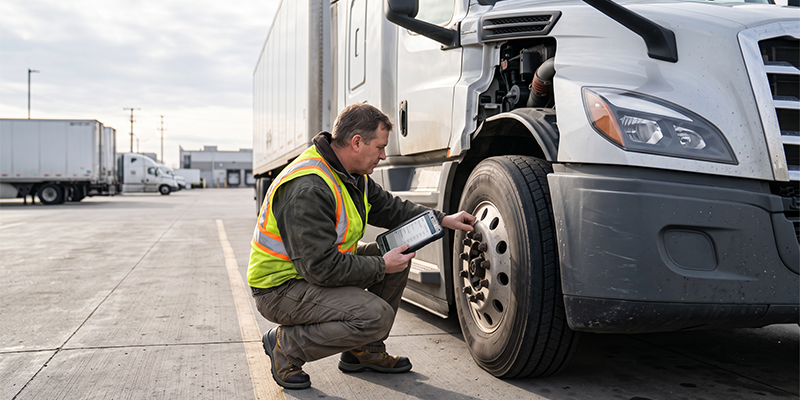
FMCSA's Compliance, Safety, Accountability program scores carriers across seven safety categories, called BASICs, including Hours of Service Compliance, Unsafe Driving, and Vehicle Maintenance. A strong CSA score is not just a compliance formality. It affects insurance premiums and how willing shippers and brokers are to award freight to a carrier.
GPS and ELD data protect CSA scores in three concrete ways.
- Preventing HOS violations before they happen, through real-time limit alerts, instead of discovering them at roadside.
- Documenting harsh braking, speeding, and other unsafe driving events, so coaching happens before a pattern turns into a citation. This is the same GPS and video data that helps fleets reconstruct what happened after an accident, which also protects the Unsafe Driving BASIC.
- Producing clean, consistent inspection and maintenance records that hold up when FMCSA reviews a carrier's BASIC scores.
Beyond Trucking, IFTA, Maintenance, and Cold Chain Compliance
Fleet compliance extends beyond long-haul trucking. GPS tracking helps businesses meet regulatory requirements across multiple operations while managing vehicles, trailers, and equipment from a single platform.
IFTA Reporting
GPS tracking automatically records mileage by state, eliminating manual trip logs and simplifying quarterly IFTA fuel tax reporting.
Maintenance Compliance
Mileage and engine hour data can trigger automated maintenance reminders, helping fleets stay on schedule and reduce the risk of DOT violations caused by overdue service.
Cold Chain and Reefer Monitoring
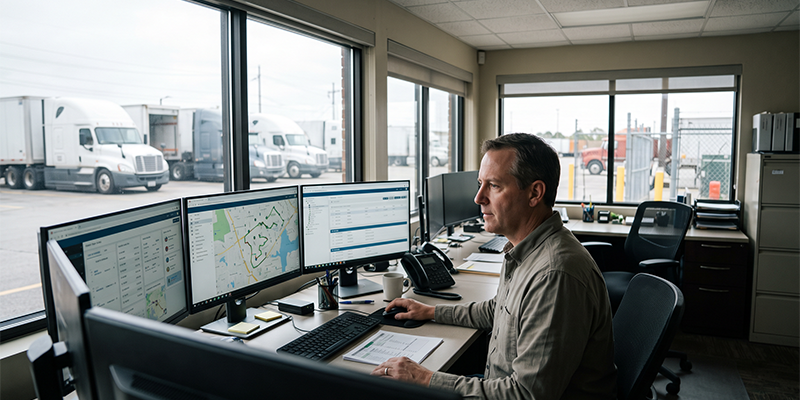
Businesses transporting temperature-sensitive freight face strict food safety requirements. GPS fleet tracking paired with remote temperature monitoring provides real-time alerts and a complete temperature history to help protect loads and support compliance.
A produce hauler running refrigerated trailers is a clear example. A single reefer unit drifting a few degrees out of range overnight can spoil an entire load and, depending on the customer, trigger its own food safety documentation requirement. Pairing GPS fleet tracking with continuous temperature logging means the alert reaches a dispatcher in minutes rather than at delivery, and the temperature history is already documented if a customer or auditor asks for it later.
A single-platform approach makes it easy to manage vehicles, trailers, and equipment in one place instead of juggling separate systems for each asset type.
A Quick Compliance Checklist
Before your next DOT inspection or audit, confirm the following.
- Your ELD is currently listed on FMCSA's registered device list, not just previously approved.
- Drivers know how to produce HOS records and required documents at roadside, even without a physical manual in the cab.
- DVIR records, electronic or paper, are complete and retrievable for every vehicle in service.
- IFTA mileage records reconcile against GPS trip data each quarter.
- Maintenance records tie back to actual mileage and engine hours, not estimated service intervals.
- Any driver or administrator who touches the Drug and Alcohol Clearinghouse has completed the current identity verification steps.
What Changed in FMCSA Rules Through Mid 2026
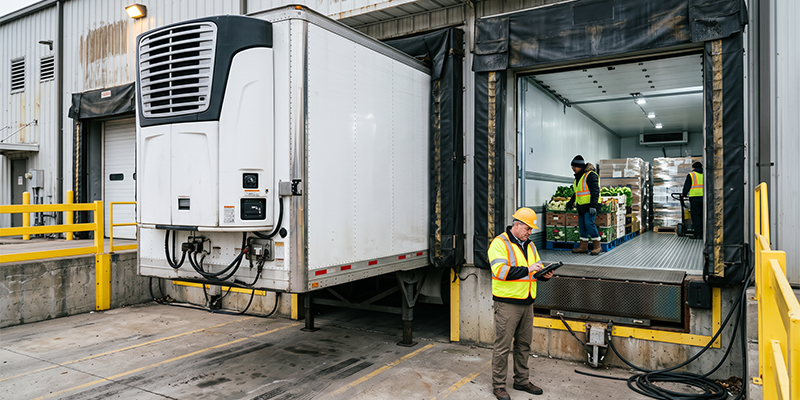
While the core Hours of Service (HOS) rules remain unchanged, several FMCSA updates took effect through mid-2026.
- eDVIR Final Rule (Effective March 23, 2026): Electronic Driver Vehicle Inspection Reports (eDVIRs) and electronic signatures are now officially permitted.
- ELD Device Revocations: FMCSA continues removing non-compliant ELDs from its registered list. Fleets must replace revoked devices within the 60-day compliance window.
- Paper ELD Manual Removed (Effective July 22, 2026): Drivers no longer need to carry a printed ELD manual but must still be able to produce HOS records during inspections.
- Drug & Alcohol Clearinghouse Updates (Effective April 27, 2026): FMCSA introduced stronger identity verification requirements for Clearinghouse users, with phased implementation.
- HOS Pilot Programs: FMCSA is testing expanded split sleeper berth options and a pause feature for the 14-hour driving window. These are limited pilot programs and do not change the current HOS rules for most fleets.
Although these updates don't change the core HOS requirements, they reinforce the need for accurate, real-time recordkeeping. A GPS-connected ELD platform helps automate compliance and simplifies documentation.
FAQs
1. Does GPS tracking meet the FMCSA ELD mandate?
No. GPS tracking shows vehicle location, while an FMCSA-registered ELD automatically records Hours of Service (HOS) data through the vehicle's engine.
2. What's the difference between a GPS tracker and an ELD?
A GPS tracker monitors location and routes. An ELD records legally compliant HOS data. Many fleet systems include both features.
3. What are the current FMCSA Hours of Service limits?
Drivers can drive up to 11 hours within a 14-hour on-duty window after 10 consecutive hours off duty, with a 30-minute break after 8 hours of driving.
4. Is a DVIR still required?
Yes. Drivers must complete a Driver Vehicle Inspection Report (DVIR), and electronic DVIRs with e-signatures are accepted.
5. Do drivers still need a paper ELD manual?
No. A printed ELD manual is no longer required, but drivers must still provide HOS records during roadside inspections.
6. What happens if my ELD is no longer FMCSA registered?
After the replacement period ends, using a revoked ELD can result in out-of-service violations. Check your device's registration regularly.
7. What is a CSA score?
A CSA score measures a carrier's safety performance across key areas like Hours of Service, unsafe driving, and vehicle maintenance.
8. Can GPS tracking help with IFTA reporting?
Yes. It automatically tracks mileage by state, making IFTA fuel tax reporting faster and more accurate.
9. Is the ELD mandate changing in 2026 or 2027?
No. The core ELD requirements remain the same, although FMCSA is testing limited pilot programs.
10. Can GPS tracking help with reefer or cold chain compliance?
Yes. GPS platforms with temperature monitoring help protect temperature-sensitive loads and support compliance.
Build a Compliance System That Works While You Drive
Fleet compliance in 2026 is no longer a once a quarter paperwork task. It is a continuous data problem, and GPS tracking, paired with a properly certified ELD, is the infrastructure that solves it.
If you are not confident your current setup genuinely meets FMCSA's HOS, DVIR, and CSA requirements, or you are managing compliance across a spreadsheet and a shoebox of paper logs, it is worth a closer look at what one integrated platform can do. See how Tracker Systems' ELD and HOS compliance solution brings scheduling awareness, vehicle inspections, and audit-ready records into a single dashboard, explore no contract monthly service plans, or talk to a specialist about what that looks like for your fleet.
Recent Posts
-

How GPS Tracking Helps Businesses Meet Fleet Compliance and Regulatory Requirements
One missed 30-minute break. One unlogged mile. That is sometimes all it takes to trigger a roadside …Oct 12th 2026 -

Calculating the ROI of GPS Fleet Tracking for Your Business
Every GPS tracking vendor will tell you that their product pays for itself. Search around, and you w …Oct 5th 2026 -

How GPS Tracking Helps Electrical Contractors Manage Multiple Crews
An electrical contractor running four crews across four job sites is effectively managing four separ …Sep 28th 2026