
GPS Tracking for HVAC Service Fleets: Improving Scheduling and Customer Response
When a customer's air conditioning fails on the hottest day of the year, the HVAC company that answers “we'll be there in 20 minutes” usually wins the job. Often it wins the customer relationship for years afterward. Response time is one of the strongest drivers of loyalty in HVAC service work, yet many dispatch decisions still get made by phone calls and guesswork rather than actual vehicle location.
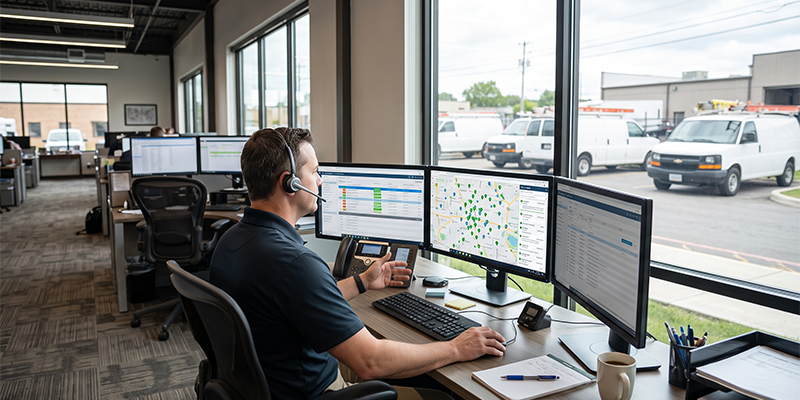
GPS tracking closes that gap. By giving dispatchers a live view of every van and technician, a GPS-connected fleet platform turns scheduling from a reactive phone-tag exercise into a real-time operational decision, and gives customers the kind of accurate arrival information they now expect from almost every service industry.
GPS tracking improves visibility across HVAC service fleets, works alongside dispatch and scheduling software, and helps businesses operate more efficiently in 2026. If you also manage plumbing or pest control vehicles, many of the same dispatch principles apply, as discussed in our related articles on GPS truck tracking for plumbing companies and pest control fleet management with GPS.
Key Takeaways
- GPS tracking and full HVAC dispatch software solve different problems. One shows you where every vehicle is; the other runs your whole scheduling and invoicing operation.
- Response time is one of the top drivers of HVAC customer loyalty, often mattering more than price during an emergency call.
- GPS location data can feed directly into the dispatch, payroll, or CRM tools an HVAC business already runs through an API, rather than replacing them.
Why Response Time Is an HVAC Business's Most Visible Metric
Response time, the elapsed time between a service request and a technician's arrival, functions as a stand-in for reliability in the eyes of an HVAC customer, often more than price. During a no-heat or no-cool emergency, a customer rarely has the context to judge technical quality in advance. What they can judge immediately is whether the company showed up when it said it would. Field service research consistently identifies response time and scheduling reliability as leading drivers of repeat business across the trades, not just HVAC.
What GPS Tracking Actually Does for an HVAC Fleet
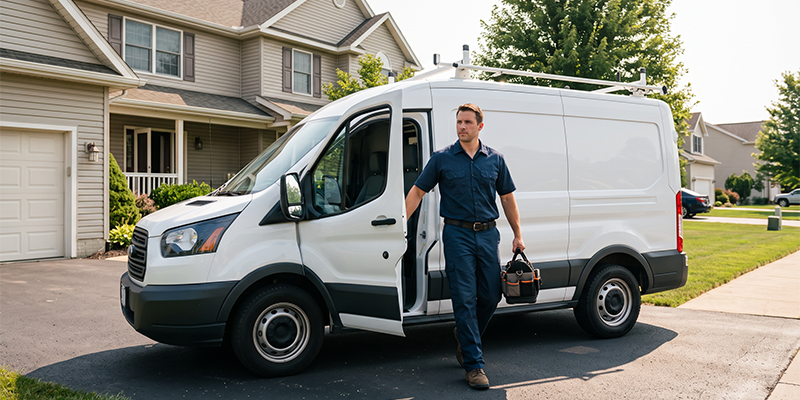
At its core, GPS tracking gives a dispatcher a live map of every vehicle in the fleet. For an HVAC business, that translates into a specific, practical set of capabilities, the kind built into Tracker Systems' service-vehicle GPS tracking:
- Nearest-technician dispatch: seeing which van is actually closest to a new job, instead of guessing or calling around.
- Accurate ETAs: generating a real arrival estimate from live location and traffic conditions, instead of a vague time window.
- Job-site arrival and departure timestamps: a record that supports billing accuracy and resolves customer disputes about how long a visit actually took.
- Idle time and after-hours alerts: visibility into unauthorized vehicle use or excessive idling that quietly adds up in fuel cost.
- Geofencing: automatic alerts when a van enters or leaves a yard, warehouse, or job site cluster.
None of this requires replacing a company's existing scheduling process. It is a visibility layer that makes the scheduling decisions a dispatcher already makes faster and more accurate.
That visibility layer extends past the vans themselves. PTO and auxiliary input monitoring can also confirm when a rooftop unit lift, generator, or compressor is actually running on a job site, which matters for HVAC companies billing by equipment usage time or verifying that a longer-than-expected visit was legitimate.
GPS Tracking vs. Full HVAC Dispatch Software: They Solve Different Problems
This is where many HVAC businesses get confused, understandably, since the marketing language for both categories overlaps heavily. A full field service management platform, the kind that bundles scheduling, invoicing, and customer records into one system, typically runs $150 to $500 or more per technician per month. A GPS or telematics platform provides the underlying vehicle location layer, usually at a small fraction of that cost per vehicle, and is built to work alongside whatever dispatch or field service software a company already uses rather than replace it.
| Capability | GPS-only fleet tracking | Full field service suite |
| Vehicle location tracking | Yes | Yes, varies by plan |
| Job scheduling and calendar | No | Yes |
| Invoicing and CRM | No | Yes |
| Typical monthly cost | Low, per vehicle | $150 to $500+ per technician |
| Works alongside your current dispatch tools | Yes, via API | Is the dispatch tool |
For a smaller HVAC operation not ready for a full software contract, or one that already has scheduling software but lacks real vehicle visibility, GPS tracking alone delivers most of the response-time and accountability benefit at a much lower cost and with no long-term commitment. Through the Tracker Systems platform, location data can feed directly into dispatch, payroll, or CRM tools a company already runs through an API, rather than forcing a system migration.
How Real-Time Location Improves Scheduling
Consider a five-van HVAC company during a July heat wave. Calls are coming in faster than the schedule was built to handle. Without GPS visibility, the dispatcher's only option is calling each technician to ask their location and estimated finish time, then guessing who to send next. With a live map, the same dispatcher sees in seconds which van is closest to the new address and which technician is genuinely close to wrapping up their current job, not just scheduled to be.
That shift matters beyond a single day. A 2026 technician survey from field service platform ServiceTrade found that miscommunication between the field and the office, and poor scheduling or last-minute changes, rank among the top productivity obstacles technicians face on the job. Live vehicle data addresses both directly: dispatchers work from what is actually happening on the road, not from a schedule that was accurate an hour ago.
HVAC companies also track first-time fix rate, the share of service calls resolved without a return visit, as a core performance metric. Industry benchmarks generally place average first-time fix rates in the 70 to 80 percent range, with 80 percent or higher considered a strong result. GPS-based dispatch does not fix a diagnostic problem or a missing part on its own, but reducing the scheduling pressure that leads to rushed assignments and mismatched technician-to-job pairings supports first-time fix performance rather than working against it. Reporting tools inside the Tracker Systems analytics dashboard make it straightforward to see where dispatch delays are actually happening across the fleet.
Customer Communication: The “On My Way” Expectation
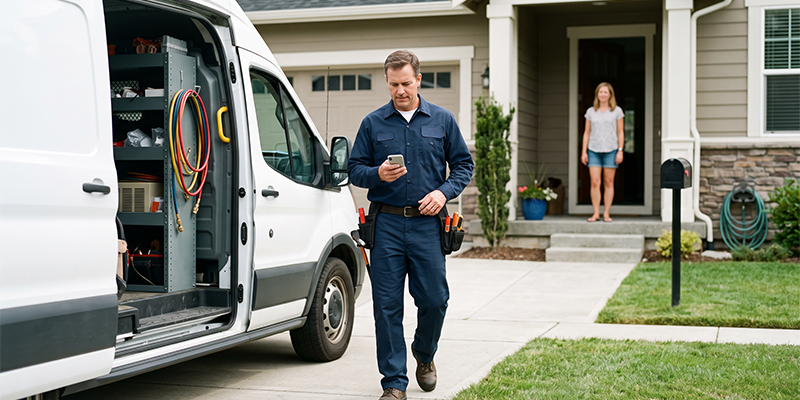
Waiting at home for hours without knowing when a technician will arrive has become one of the biggest frustrations for service customers. In 2026, businesses are addressing that problem with automatic "technician is on the way" texts triggered by real-time GPS data rather than manual updates. A GPS-connected platform allows office staff, or an automated workflow, to send customers an accurate arrival window instead of a safety-padded estimate. As a result, customers stay informed about their technician's arrival, and businesses receive fewer "Where are you?" calls that would otherwise tie up the office phone lines.
Protecting Technician Time and Billing Accuracy
GPS job-site arrival and departure timestamps do more than improve dispatching. They create an accurate record that helps businesses:
- Resolve customer billing disputes with verified arrival and departure times.
- Confirm that reported work hours match the technician's actual time on-site.
- Ensure company vehicles are being used appropriately during working hours.
This isn't about constantly monitoring technicians. Most HVAC business owners find that simply having GPS records available encourages accountability and reduces misunderstandings.
For example, a technician reports spending two hours on a service call, but the customer believes the visit was much shorter and disputes the invoice. Without GPS data, the office may have to rely on memory or reduce the bill to preserve the customer relationship. With GPS arrival and departure timestamps, staff can verify exactly how long the technician was on-site and resolve the dispute using accurate records instead of assumptions.
A Quick Implementation Checklist for HVAC Fleets
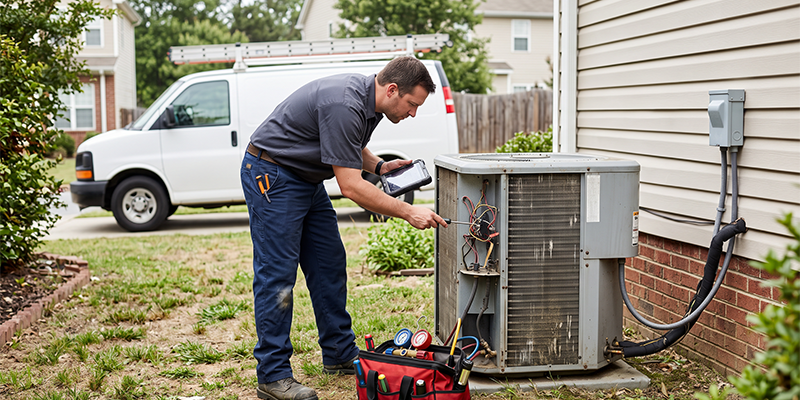
- Start with your service vans first. They represent the highest daily operating cost and the most dispatch-relevant asset.
- Choose hardwired tracking for owned, long-term fleet vehicles and OBD2 plug-in tracking for leased or frequently rotated vehicles.
- Set up a nearest-technician dispatch habit before adding a full field service platform. Most of the response-time benefit shows up immediately, before any software migration.
- Geofence your yard, warehouse, and common job-site clusters to catch after-hours use automatically.
- Pick a reporting interval that matches how the vehicle is used. Frequent updates while moving, less frequent while parked, keeps data useful without unnecessary cost.
What's Shaping HVAC Field Service in 2026
According to Grand View Research, the global field service management software market was valued at roughly $4.4 billion in 2022 and is projected to reach about $11.8 billion by 2030, growing at a compound annual rate near 13 percent. Estimates vary by research firm, but every major analysis points the same direction: HVAC and other trade businesses are moving toward connected, software-driven operations rather than spreadsheets and phone calls, and toward hybrid teams of employees and contractors.
The practical direction for a fleet is straightforward. AI-assisted route optimization is starting to appear inside major field service platforms, and that optimization runs on the same input GPS tracking already provides: accurate, real-time vehicle location. Fleets that build that data foundation now are better positioned to adopt the scheduling tools coming next, rather than starting from scratch later.
There is also a labor angle worth noting. Recent contractor surveys point to miscommunication and scheduling friction, not lack of technical skill, as the top complaints technicians raise about their day-to-day work. Real-time location and job data, available on a phone rather than requiring a call to dispatch, is one of the more direct ways to remove that friction.
FAQs
1. How does GPS tracking help HVAC dispatch?
GPS tracking lets dispatchers see every service van in real time, making it easy to send the nearest available technician and reduce travel time.
2. Is GPS tracking the same as HVAC dispatch software?
No. GPS tracking shows live vehicle locations, while HVAC dispatch software also includes scheduling, invoicing, customer management, and more.
3. What is first time fix rate in HVAC?
First time fix rate measures how often technicians resolve a service call on the first visit. A rate of 80% or higher is generally considered strong.
4. Can GPS tracking improve first time fix rate?
Not directly. However, it helps dispatch teams assign the right technician faster, improving efficiency and supporting better first visit outcomes.
5. What is an "on my way" text in field service?
An automated text triggered by GPS that gives customers an accurate technician arrival time instead of a broad service window.
6. How much does GPS tracking cost compared to full dispatch software?
GPS-only fleet tracking typically costs a small monthly fee per vehicle, with plans starting from Tracker Systems' monthly service options. Full field service management platforms with built-in dispatch, invoicing, and CRM commonly run $150 to $500 or more per technician per month.
7. Do I need a full field service platform to use GPS tracking?
No. GPS tracking works as a standalone tool for vehicle visibility and dispatch, and can also integrate with dispatch or CRM software a business already uses through an API, without requiring a platform switch.
8. How does GPS tracking help with HVAC billing disputes?
GPS platforms log job-site arrival and departure times for every vehicle. That record gives an HVAC business a factual basis to confirm how long a technician was actually on-site if a customer disputes an invoice.
9. What type of GPS tracker is best for HVAC service vans?
Hardwired trackers suit owned, long-term fleet vehicles because they draw continuous power and resist tampering. OBD2 plug-in trackers suit leased or frequently rotated vehicles because they install in minutes with no wiring.
10. Does GPS tracking help with technician accountability?
Yes. Real-time location, geofence alerts, and job-site timestamps give managers an objective record of vehicle use and time on-site, which supports fair, data-based conversations rather than assumptions.
11. What should an HVAC business track first when adopting GPS technology?
Start with service vans, since they represent the highest daily operating cost and the most dispatch-relevant asset, before expanding to tools, equipment trailers, or other assets.
Building Toward Faster, More Accountable Dispatch
GPS tracking will not replace a dispatcher's judgment, and it is not a substitute for a full field service platform if your HVAC business is ready for one. What it does is remove the guesswork underneath every dispatch decision: which van is actually closest, how long a job has really taken, and whether a customer's arrival estimate is accurate or just hopeful.
If your HVAC fleet wants that visibility without a long-term software contract, or wants it feeding directly into the dispatch tools you already use, take a look at Tracker Systems' service-vehicle GPS tracking, or talk to a specialist to find the right setup for your fleet.
Recent Posts
-

How GPS Tracking Helps Businesses Meet Fleet Compliance and Regulatory Requirements
One missed 30-minute break. One unlogged mile. That is sometimes all it takes to trigger a roadside …Oct 12th 2026 -

Calculating the ROI of GPS Fleet Tracking for Your Business
Every GPS tracking vendor will tell you that their product pays for itself. Search around, and you w …Oct 5th 2026 -

How GPS Tracking Helps Electrical Contractors Manage Multiple Crews
An electrical contractor running four crews across four job sites is effectively managing four separ …Sep 28th 2026